
Sand Dunes in Cornwall

Cornwall's ever-changing sand dunes contrast greatly with the rugged high cliffs bordering most of the county. As weather conditions are always changing, so are sand dunes – they are never ‘finished’. The sea can both wash areas of dunes away and bring more sand for dune-building. The wind frequently changes which way it is blowing and how strong it is blowing, so it can move sand in all directions. Sand dunes, which cover approximately 2% of the area of Cornwall, are important both as natural sea defences and as special places for wildlife and cultural history.
The Importance of Sand Dunes
The 2 Minute Foundation, with support from Making Space for Sand, have created a series of short films that explores the formation, importance, and preservation of sand dunes. Each episode dives into how these natural landscapes protect coastlines, support biodiversity, and mitigate the effects of climate change. Through stunning visuals and expert insights, the series emphasizes the need for conservation efforts to restore and safeguard these fragile ecosystems.
Simply click the images below to watch each episode!



Coastal Change Educational Resource Pack KS3

The Making Space for Sand project has supported project partners South West Coastal Monitoring and Geography South West, to create a KS3 geography resource pack about Cornwall’s dynamic coastal landscapes.
Through four lessons, students learn how sand dunes form, how they change, and why they are important but vulnerable. Using maps, aerial photos, historical records, and modern data, students build a clear understanding of key coastal processes such as deposition, erosion, accretion, coastal rollback, and the impacts of climate change.
Lesson 1: Students begin by exploring the formation and importance of sand dunes.
Lesson 2: They will investigate changing beach environments at Par Sands.
Lesson 3: Focuses on Gwithian Towans, where students explore how physical processes and human activity.
Lesson 4: Uses a case study at Penhale to develop critical thinking and decision-making skills
Together, these resources align to key KS3 geography curriculum themes including:
- Coastal processes and landforms
- Climate change and sea level rise
- Human impacts on physical landscapes
- Sustainable development and environmental management
- Geographical enquiry and decision-making skills
Coastal Change Educational Resource Pack GCSE
The Making Space for Sand project has supported partners South West Coastal Monitoring and Geography South West to develop a new GCSE geography resource pack exploring Cornwall and Devon's dynamic coastal landscapes.
Using three detailed case studies, students investigate coastal landforms and coastal management approaches through real-world examples, maps, aerial imagery, photographs, historical records and contemporary data. The resources also help build GCSE-style geographical enquiry, evidence interpretation and revision skills while connecting learning to current coastal challenges.
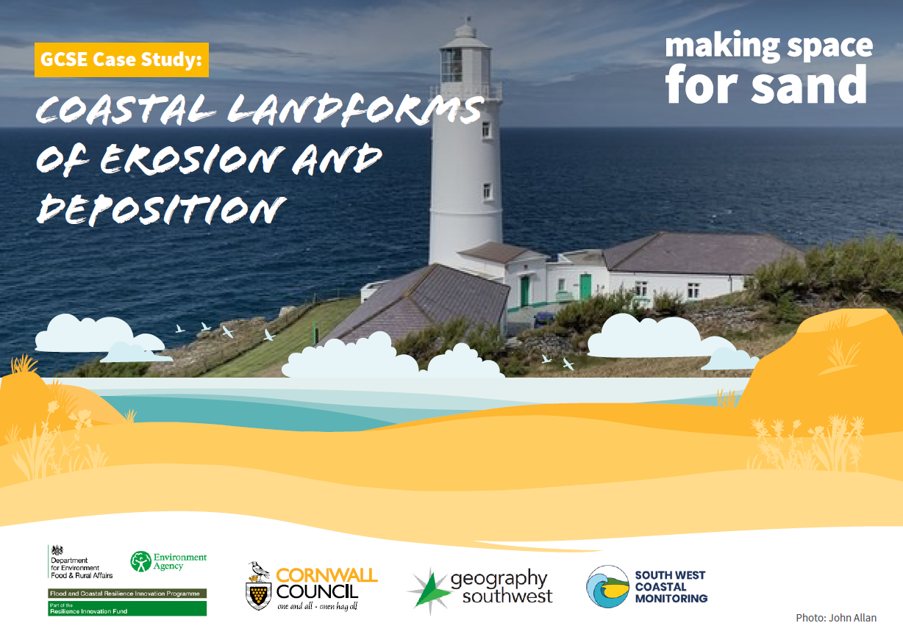
Case Study One - Coastal landforms of erosion and deposition – Trevose Head, Cornwall
Students explore a range of coastal landforms around Trevose Head, including headlands, bays, caves, stacks, blowholes, wave-cut platforms and beaches. The case study also explores the formation of sand dunes at Constantine Bay and Treyarnon Bay and the effect of beach change on the dunes. Students will investigate the role of waves and how variations in the wave and rock type, alongside the processes responsible for coastal erosion and deposition, have shaped the coastline.
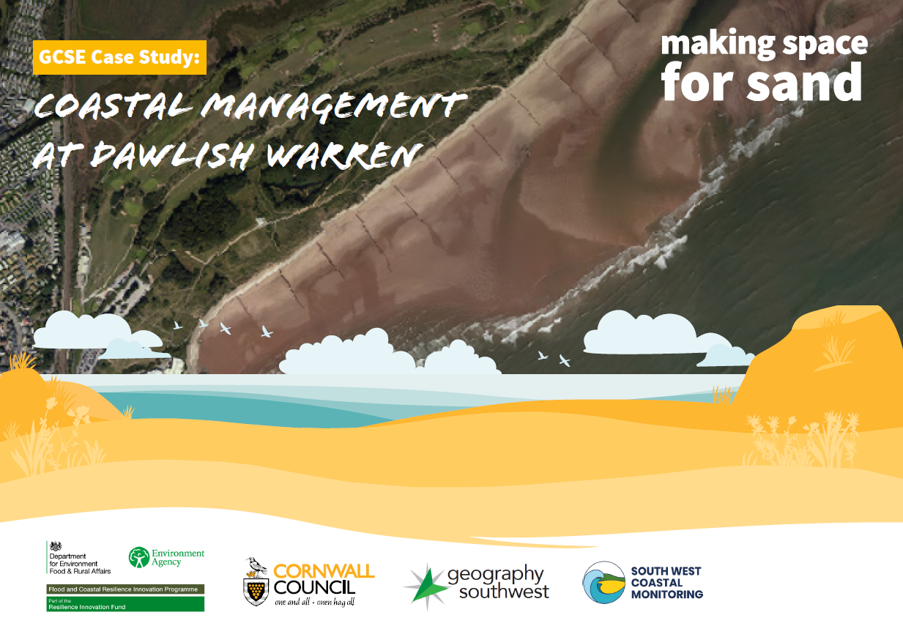
Case Study Two - Coastal Management Dawlish Warren Devon
Students will learn about the different coastal management approaches and how these have been applied at Dawlish Warren. Students investigate and discuss why Dawlish Warren is an important but vulnerable coastal environment. They will explore the highly dynamic sand spit, environmental threats posed by climate change and sea level rise, and the socio-economic and environmental reasons for managing the area. Students will examine the different approaches used at the site, before evaluating the success of these approaches and considering the long-term future of Dawlish Warren.
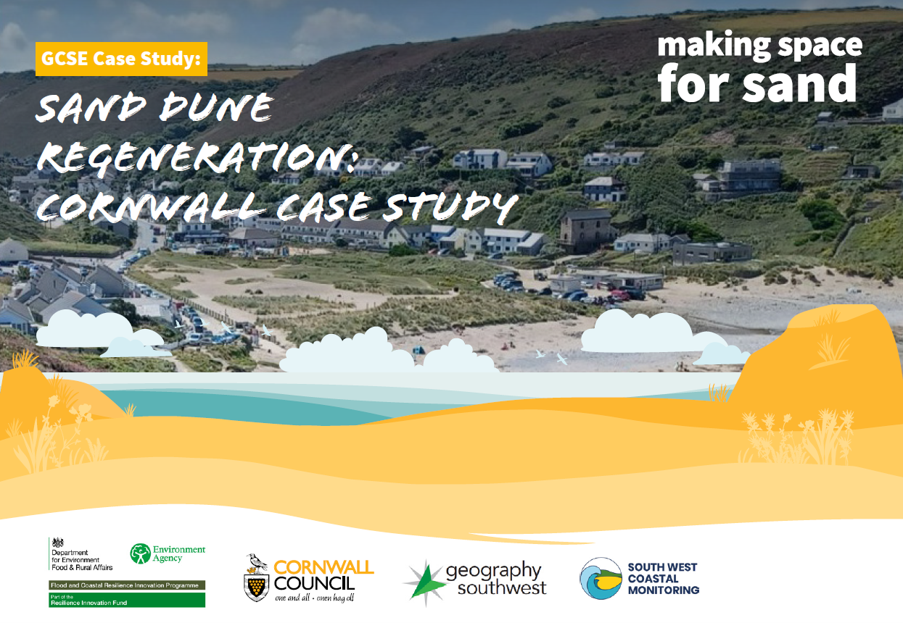
Case Study Three - Sand Dune Regeneration Cornwall
Students explore sand dune regeneration as an example of soft engineering and investigate how dunes can be protected, restored and managed. They examine the role of marram grass, fencing, Christmas trees and sand dune notches, using examples from Widemouth Bay, Penhale and Porthtowan, allowing students to investigate how communities and coastal managers are working with natural processes to improve dune resilience, protect coastal communities and enhance biodiversity.
Together, these resources support key GCSE geography curriculum themes including:
- Coastal processes and landforms
- Coastal erosion and deposition
- Coastal management and engineering
- Physical and human factors affecting coastal environments
- Climate change and sea level rise
- Sustainable coastal management
- Geographical enquiry and interpretation of evidence
- Evaluation and decision-making
- Case-study knowledge and revision
How do coastal sand dunes form?
As the name suggests, sand dunes are mostly made of sand! Sand is defined by the size of particles (smaller than gravel but bigger than silt) so can contain a mixture of different things:
- Shell Sand is formed when the hard parts of marine animals are broken down and ground up. Shell sand has lots of calcium carbonate in it (the stuff that your teeth and bones are mostly made of).
- River Sand is made when hard rocks are slowly broken down or eroded by weathering. The rivers carry this sand to the sea where it can end up being blown along the beach.
- Crumbling Cliffs along the coastline can be eroded and weathered away to form sand.
For coastal dunes to form, there needs to be a supply of sand, strong onshore winds and a gently sloping shore. As these conditions are ever changing, dunes are constantly re-sculpted and considered very dynamic, unique environments.
Wind can dry sand and blow it up and along the beach until it meets an obstacle, such as driftwood, pebbles or any other debris on the shore. The obstacle slows down the wind, causing it to lose energy and drop the sand it was carrying. The sand may then pile up around the obstacle, but with nothing to bind this loose sand together it will probably be moved again by the wind or the sea; the sand needs plants to form a dune!
If the right kind of seeds find their way into the sand, some highly adapted plants may grow and help to form an ‘embryo dune’. As these plants grow, their underground roots bind the sand together and their presence above ground slows the wind, causing more sand to be deposited, enabling the dune to grow.
Image of embryo dunes associated with Par Sands
When plants in the dune die, they decompose, adding organic material or ‘humus’ into the sand. This process gradually changes the characteristics of the sand, allowing it to hold more water and provide minerals to other plants. This change in the sand’s characteristics allows a greater diversity of plants to grow, which can support an ever-wider range of animals. This process of change is known as ‘ecological succession’. As succession continues and more sand gets blown up from the beach, dunes get bigger with increased cover of plants, including many less specialised species that can now survive in these ‘fixed’ dunes.
Sand dune plants and animals
Healthy sand dune systems are home to a huge mix of fascinating wildlife, including all sorts of plants, lichens, fungi, invertebrates, reptiles, amphibians, birds and mammals. Many plants that grow in the dunes may have adaptations that allow them to thrive in extreme conditions, especially ‘pioneer’ species, which are the first ones to colonise bare sand. For example, they may be:
- tolerant of high levels of salt (Halophytic), such as sand couch grass
- tolerant of very dry conditions (Xerophytic), such as sea rocket
- able to keep growing when buried under windblown sand, such as marram grass
Image of sea rocket growing in an embryo dune

Sand dunes are considered to be one of the most ecologically important habitats in the UK. This is partly as dunes contain habitats that are not found anywhere else. Within these habitats in Cornwall we are lucky to have some nationally scarce species growing, such as sea knotgrass and prickly saltwort.
It's not only rare plants that occur in sand dunes, but sand dunes also provide habitat to a variety of invertebrate and reptile species. Cornwall’s dunes are home to populations of the silver-studded blue butterfly, glow-worms, mining bees, grass snakes, adders and even sand lizards!
Image of a rabbit grazing on dune grasses (Image courtesy of Ellie Chidgey)
Invasive Non-Native Species (INNS) are usually plants and animals that are not considered native to the UK. These species have been imported (intentionally or otherwise) from other countries where they may not be problematic. Many non-native species will not be a problem (species have always migrated); a species only becomes invasive when it has escaped controlling species (i.e. predators, herbivores, parasites or pathogens), which would have otherwise limited their survival. Without these controls, the invasive species may spread quickly and out-compete native species. This potentially reduces the diversity of species living in our dunes and affects the way that they function.
Image of Japanese Rose growing in Mawgan Porth dunes
Within Cornish dune systems there are several invasive species that threaten dune health, including cotoneaster, sea buckthorn, clematis, montbretia and Japanese rose. Often these plants have been introduced for a specific purpose, or may have escaped from gardens, without the consequences being fully understood. Though these plants can look pretty and do support some wildlife, they are usually tall and fast-growing plants that can become dominant, smothering native wildflowers. The management of invasive species is, therefore, fundamental to the recovery of Cornwall’s dune systems and the native wildlife they support.



Sand dunes; a natural coastal defence
When we think of coastal defences, often it’s concrete seawalls and rock armour that comes to mind. Though these engineered structures do provide defence against large swells and storm events, they can also have an impact on the quality of the local environment and on how sand moves, are expensive to build and maintain and so are not always considered suitable or appropriate. Healthy coastal dunes also play an important role in coastal protection as they provide us with an essential ‘ecosystem service’, large dunes can provide shelter from coastal flooding and the worst of the winds during storms.
Image of marram grass growing on the edge of a blowout feature
Coastal sand is an effective and natural coastal defence, as it is good at absorbing and spreading out the energy of the sea. In some instances, where conditions are right, it forms dunes. These dunes create an important store of sand that can both directly absorb wave energy and (when eroding) feed beaches with sand, which also reduces wave energy. The ability of beaches and dunes to act as natural coastal defence features and provide ecosystem services is dependent on the availability of sediment or sand and on them having space to change and move over time.
Image across Constantine Dunes of Trevose Head
Historically, development of roads, buildings and other infrastructure on and around coastal dunes often hasn’t considered how mobile they can be. Unfortunately, this can result in dunes being marginalised to the edge of the built environment, squeezing them into smaller spaces and limiting their potential to store sand and to be effective coastal defences. If we want dunes to be effective sea defences, which can naturally change and move over time, we need to make space for them to do their thing.
Our impact on dunes
The major sand dunes of Cornwall are thought to have originated more than 5000 years ago and have been used by people ever since. Human use of the dunes has impacted on how they have changed during this time and our actions today continue to affect dunes: how well they function as a sea defence, how sustainable they are, how dynamic they are and how full of wildlife they are.
The coastline has become a popular area to both live and visit. As a result, some areas of dune have been developed for residential or commercial purposes, often with roads and car parks built on them to improve access to Cornwall’s beaches. However, some of these developments limit the ability of dunes to naturally respond to extreme weather events and rising sea levels. The more we understand about dunes the better we can make informed decisions about suitable and sustainable development in these areas.

People visiting the coastline have the potential to impact both positively and negatively on the health of coastal dunes. Footfall through dunes can actually help to introduce greater diversity to some dune systems but excessive, repeated, trampling at other sites can result in the loss of the plants that bind the sand together.
Dog walkers, particularly, have the power to control their impacts. When a dog is by their owner’s side the impact is minimal, but if running free they can disturb wildlife and worry grazing animals. If dog waste is not collected it can fertilise the dunes, which is bad news for wildflowers, which are adapted to nutrient poor conditions.
Litter is another problem; not only does it look unsightly, but it also has the potential to smother plants, be accidently eaten by animals or even cause fires (single use barbecues can be real issue). We can all make a difference when it comes to our impacts on the dunes; following local guidance on access, wildlife and other issues is a good start.
Sand dune surveys
The Making Space for Sand project will deliver baseline habitat assessments at each of the project sites. Further habitat surveys will be carried out on a number of locations to identify broad habitat zonation and identify rare/protected species. This will create an important baseline of information that can be used in the future to monitor how dune habitats have changed.
Biodiversity Net Gain, or BNG, is part of a nationwide objective to ensure that any kind of development shows a minimum 10% increase in habitat units post development. The principles of this are being applied to the Making Space for Sand project. A selection of sites will be assessed for their ‘baseline’ BNG score. Following this, a series of management recommendations will be made, and the site will be monitored and reassessed against the criteria to see if biodiversity is improving. This may result in management actions such as invasive species control, removal of scrub or changes to bare sand extents, in order to encourage a greater diversity and resilience of habitats.
Please visit the Location page of the website to view the ecological reports where they have been completed.
We have a lot to celebrate in Cornwall’s sand dunes and the ecological surveys being conducted will be a showcase of this. However, our dunes are constrained by a number of other factors which threaten them. This includes development, which restricts their natural ecological successional processes, and the presence of invasive species, which are establishing dominance across many of our sites.
Sign up to Making Space for Sand
If you would like to get involved in helping to make dunes more resilient and biodiverse, want to help develop coastal adaptation and emergency plans or just want to know more about what the project is learning about coastal change, please click here: