
In February, project partner University of Plymouth presented the findings of some of their research, partly funded by the project, at one of the world’s largest ocean science conferences, the 2026 Ocean Sciences Meeting (OSM) in Glasgow. Presentations focused on the key themes of ocean science, climate change, and coastal processes. The UoP presentation was entitled “Greening and Loss of Cornwall’s Dune Systems,”. This was delivered to more than 6,500 delegates from 60 countries and helped to raise awareness of the Making Space for Sand project. This year’s meeting was also recognised as an official action of the United Nations Decade of Ocean Science for Sustainable Development.
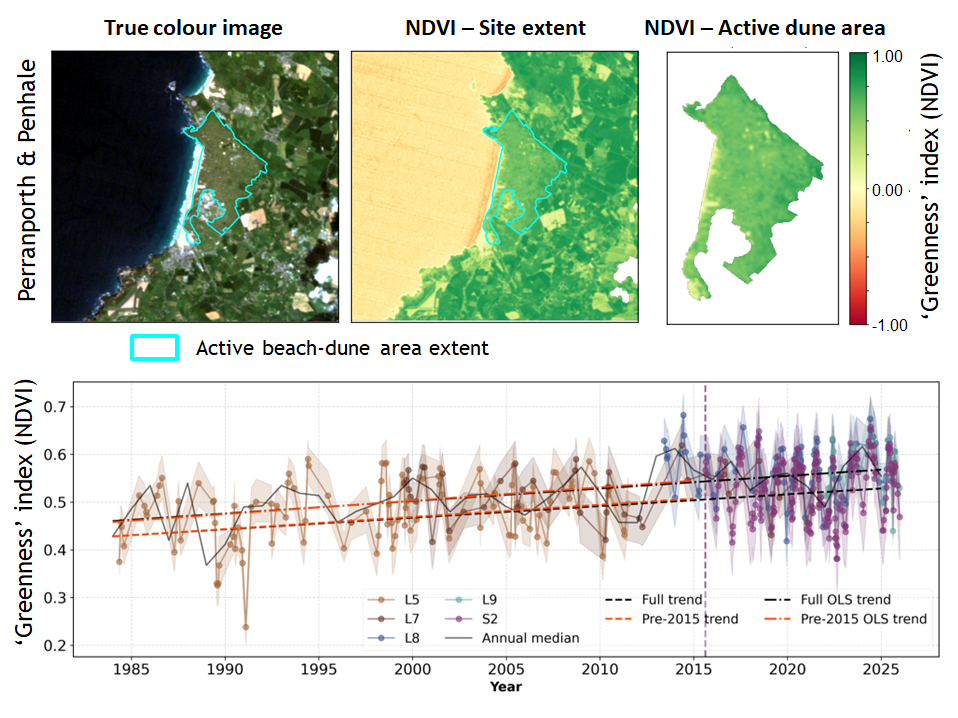
UoPs research reveals significant long-term losses in active dune areas across most MS4S sites over the past 180 years, with the steepest declines occurring since the Second World War. The team also identified a clear increase in vegetation, or “greening,” at two major dune systems—Perranporth and Penhale, and Mexico Towans—linked mainly to rising temperatures and increased rainfall driven by climate change.
Dune Greening
Above: Example of how the ‘greenness’ of the dunes is assessed using a measure of vegetation cover (NDVI) over the active dune area (light blue boundary) derived using colour information from the satellite imagery. The higher the NDVI value, the more vegetation cover. Bottom: time series of average NDVI values derived at the Perranporth and Penhale dune system from all available satellite imagery since 1984 showing a clear increasing trend. Data from different satellites are shown in different colours and the trend lines derived using different statistical approaches are also shown (dashed lines).


Making Space for Sand News and Events
We like to keep supporters of our project well informed of project progress and developments. We also want to share news of events which are happening and have happened and celebrate coastal community involvement.
Sign up to Making Space for Sand
If you would like to get involved in helping to make dunes more resilient and biodiverse, want to help develop coastal adaptation and emergency plans or just want to know more about what the project is learning about coastal change, please click here: